
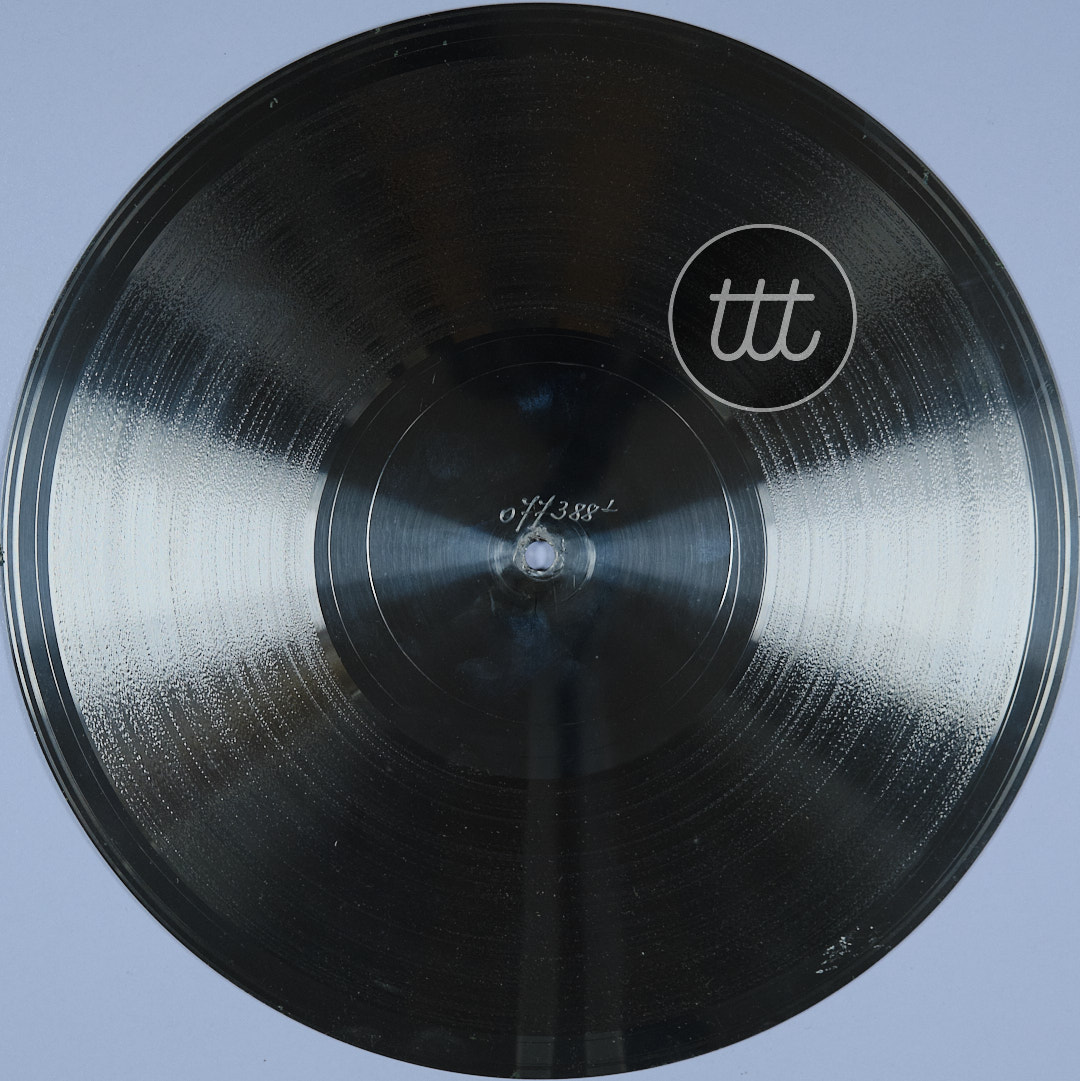
At the Summer 2026 edition of ‘La cita de los amigos’, Richard Garrido played a set from shellac records. A shellac set is always a special occasion because it involves transporting from home a large number of shellac discs, which are bulky, heavy and fragile.
While he was setting up in the afternoon he invited me over to listen to a disc he had on the turntable, which was Ricardo Tanturi’s Malvón. But this disc was not the shellac disc released by RCA-Victor in November 1943: it was a mother master.
Now what is a mother master? It’s not the original master, which is made from wax coated in metal, but it is two steps closer to that than a shellac disc. It is a direct metal copy of the master. From this, the stampers are prepared, which are used to press the shellac records. A stamper might last (say) 1000 records before it wears out, whereupon it is replaced by another. Preparing the stampers not from the unique master but from a mother master preserves the original master from wear. Tanturi was somehow able to give this mother master to a friend.
Richard passed me the headphones, spun up the turntable and dropped the needle. During the first minute – the instrumental introduction – I was certainly impressed by the clarity and especially the low noise, but actually my impression was not so very different from the best available transfer (which up till now has been that of TangoTunes). Then Enrique Campos began to sing and my mind was just blown away. Campos sounded as though he was standing right next to me. Just thinking about it now I get goosebumps.
Richard explained to me that this was a consequence of the microphone used, which was a ribbon microphone made by RCA. You can see the young Frank Sinatra using one in the photograph below

Frank Sinatra at Columbia Recording studios, Liederkrantz Hall, New York, 1st Oct 1947 (Photo by William Gottlieb/Redferns)
The RCA ribbon microphones had a warm and forgiving tone but the Telefunken microphones used by Victor’s competitor Odeon, which used the competing technology (they were condenser microphones) were also very good – just listen to Troilo’s Comme il faut if you need convincing! More significant however was the pattern – the variation in sensitivity from different directions. Ribbon microphones are bidirectional, which meant that they are equally sensitive from the front and the back. Back in 1943 studios still only used a single microphone so Victor could put the microphone in front of the Tanturi orchestra and then have Campos stand on the other side, and this is what was responsible for the exceptional presence of Campos’s voice.
As I listened on I noticed I could hear subtle changes in the volume of Campos’s vocals. This improved dynamic extended also to the orchestra. When Campos has sung his verse and chorus there’s a short instrumental break which ends with a sharp chord on the bandoneons (2’32”). This I heard as never before, with the sharp crescendo sending a frisson through my whole body; in my mind’s eye, I could see the whole bandoneon section suddenly pull violently on the bellows. At the end of the three minutes I was speechless, with my eyes full of tears. This is what all the music had originally sounded like. Richard explains that this exceptional dynamic range tells us that there was no compression during the recording: the limit was the shellac.
Would you like to have this experience too? Well, I can’t offer you that, but you can have the next best thing. Richard lent his disc (which he had bought from some guy who had “got it from his grandfather:) to Tango Time Travel, and last Christmas (2025), without much fanfare, it was released. Just buy one okay? You can thank me later.
POSTSCRIPT
I always used to think that Odeon technology was “better” than Victor’s – it sounded better to me, and often still does. Listen for example to the sound of Alberto Marino recording with Troilo on Victor; it sounds as if his voice is not very easy to record. On the records he made when he turned solo – recorded on Odeon – he sounds better. But Campos is just amazing on this disc – what is happening?
Jens-Ingo Brodesser, who spends a lot of time with these old records, has suggested an answer: the Victor shellacs simply haven’t aged as well as those made by Odeon. In other words: back in the 1940s, the discs of Troilo, Di Sarli, D’Arienzo and Tanturi sounded much better than they do now.
POST-POSTSCRIPT
Carlos Puente tells us that the mother master of Malvón was transferred and issued on LP way back in 1969! However, reverb was added to the sound, rather spoiling the benefits.


 The majority of the pictures of the great tango musicians of the past were taken by just a handful of photographers. Today I want to introduce you to the most prolific: Sivul Wilenski, who is now forgotten by all save for a small group of enthusiasts. Born in Poland in 1897, Wilenski came to Buenos Aires in 1920 as a member of Iván Totsoff’s theatre company. Here he became interested in photography and started getting work after some years at the newspaper La Razón, taking photographs of society beauties for the “Notas Societas” pages. When La Razón opened an office in Paris he was sent there to open an exhibition of his photographs, staying for three years whilst he apprenticed himself to Parisian studios, developing himself as a photographer. His son Osias says that Sivul was much influenced by French poetic cinema – think of the films of Jean Renoir such as La Grande Illusion (1937) and The Rules of the Game (1939).


